
You are currently browsing the tag archive for the ‘lgbtqia’ tag.
2024 was a BIG year. On June 6, The Greatest Menace team attended state parliament in Sydney as guests of the Premier of New South Wales, Chris Minns, as he formally apologised to the LGBTQIA+ community for injustices suffered before homosexuality was decriminalised in 1984. The apology was partly triggered by our podcast. Pat, Simon, and I listened along with TGM contributors Jacquie Grant, a trans woman and former inmate of Cooma Prison, and gay couple of 55 years Terry Goulden and John Greenway, as politicians of all stripes spoke of their regret at the demonisation visited on the LGBTQIA+ community until 1984.
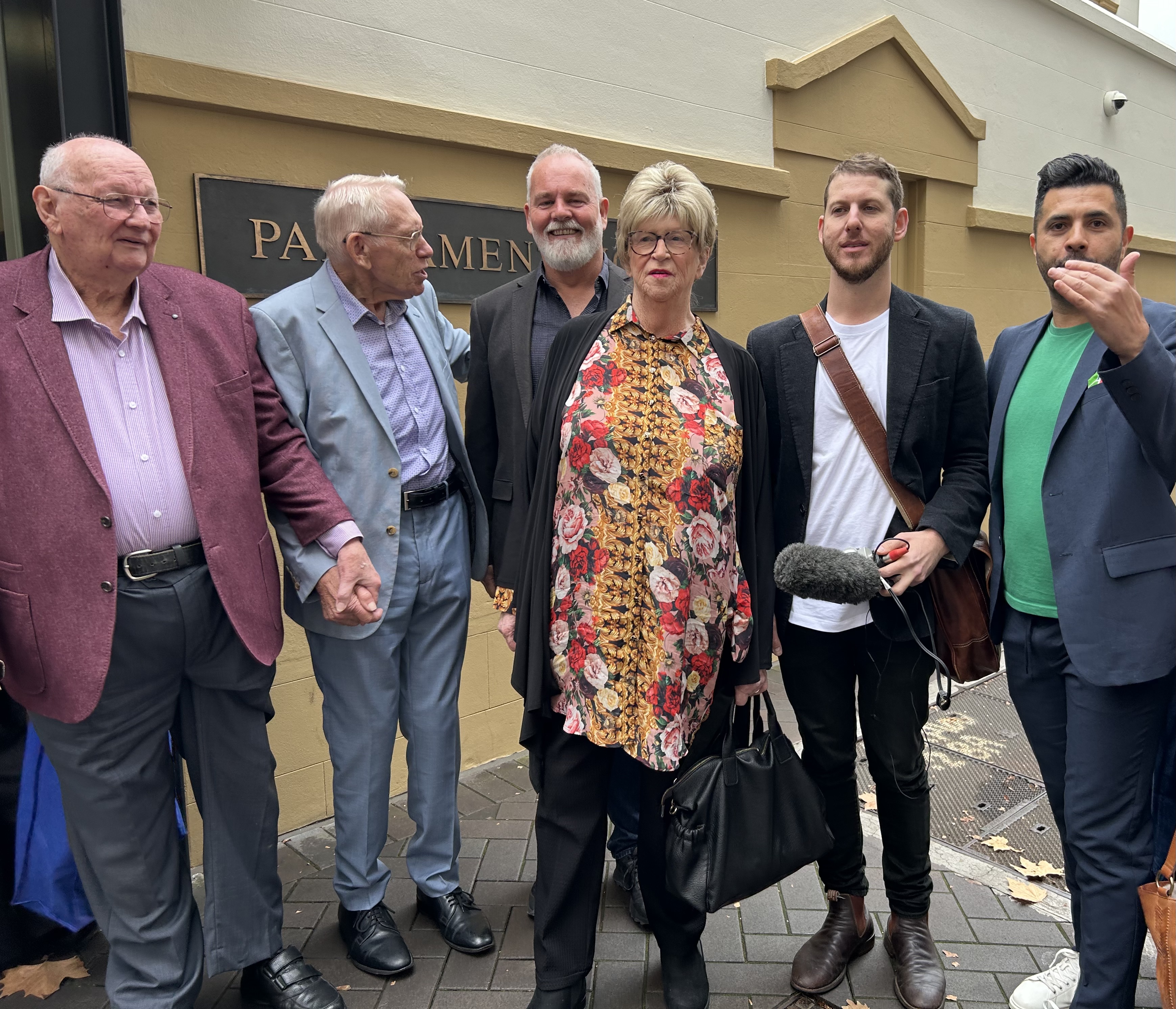
Outside Parliament House, Sydney, 6 June 2024, before the apology. From left, Terry Goulden and his husband John Greenway; Paul Horan, executive producer, Audible; Jacquie Grant; Simon Cunich; Pat Abboud, beckoning to Siobhán McHugh to join the photo rather than take it.
I wrote an in-depth article that analyses the making of the podcast: ‘Intimacy, Trust, and Justice on The Greatest Menace, a Podcast Exposing a “Gay Prison”.’ It’s published in the open access journal Media and Communication – download free pdf HERE.
Podcast Studies Roundtable, IAMCR 2024, Brisbane
Also in June, I co-convened, with Prof Mia Lindgren, the first ever Podcast Studies preconference event at the IAMCR (International Association of Media and Communications Research) conference. Organised with help from fellow pod scholars Dr Dylan Bird and Lea Redfern, it was a wonderful sharing and celebration of academic podcast research. We deliberately kept the event small and intimate, the 18 scholars from four continents forming a proto Podcast Think Tank that we hope will continue to develop research networks and collaborations – see the full report on proceedings.
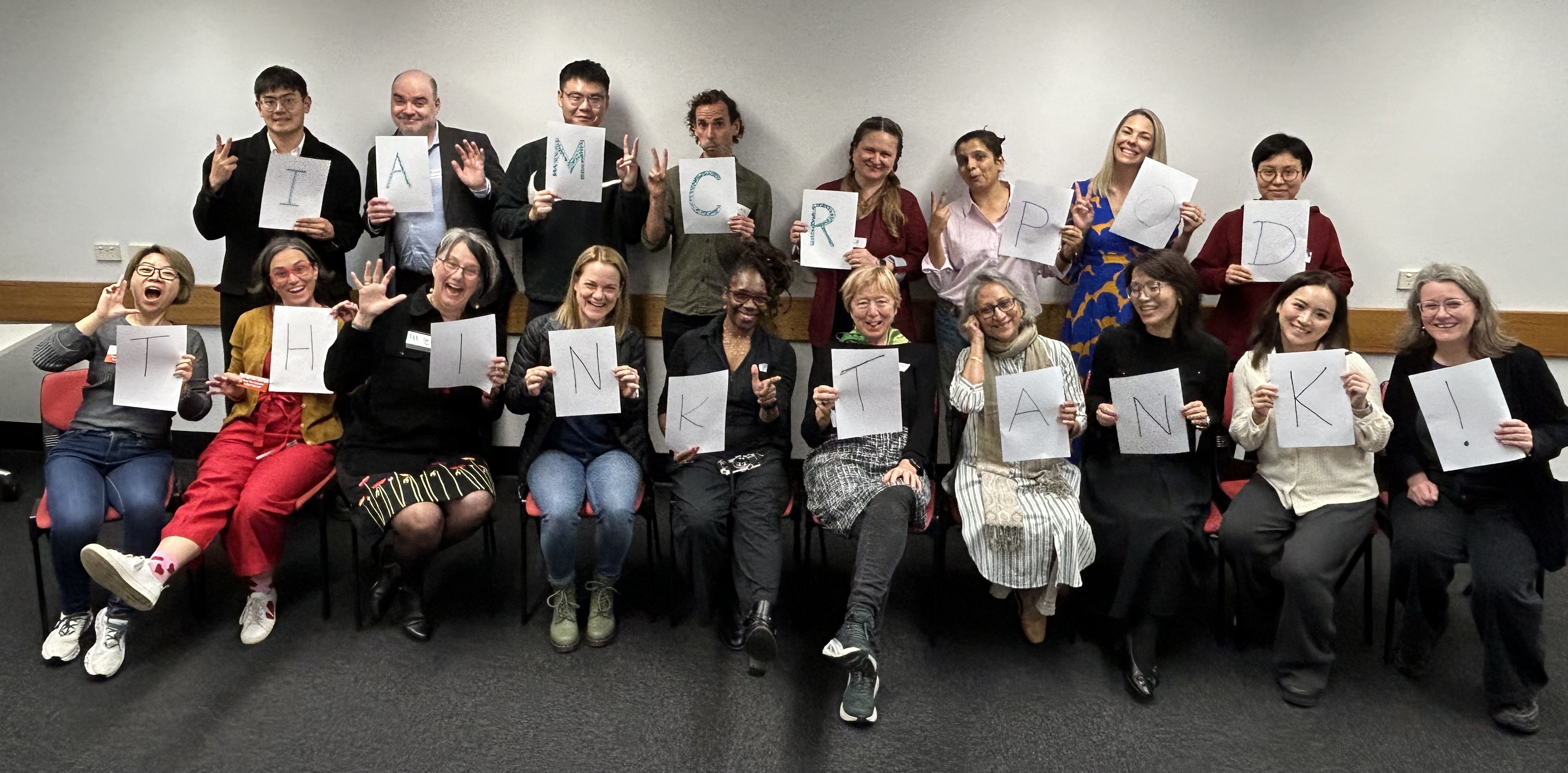
Pod scholars from China, India, the US, Africa and Australia letting loose after an intense, rewarding – and fun! – day.
HEART of ARTNESS – Season 2
Back home in early July to another intimate podcast gathering: the reconvening of the team from Heart of Artness. We used the excellent Rodecaster kit to record a stimulating chat in my lounge room that will (one day!) kick off a second season. It will incorporate interviews I did a while back now with Indigenous artists such as Archie Moore, whose breathtaking work, Kith and Kin, won the Golden Lion award at the Venice Biennale in April 2024 – the highest global accolade. Archie was already meditating in our interview on the ruptures wrought by colonisation which he explores in his Biennale installation.

Team from Heart of Artness podcast preparing for S2: Guy Freer, technical producer; Ian McLean, art historian; me and Margo Neale, co-hosts.
Filmed interviews & lectures from Sydney to Madrid
In September, I was pleased to give a series of guest lectures on everything from podcast aesthetics to ethics, to media/sound students at Macquarie University, where I am Honorary Associate Professor in the Dept of Media, Communications, Creative Arts, Language, and Literature. I’m also a member of their dynamic Creative Documentary Research Centre. So I was delighted to be interviewed for the CDRC by colleague Dr Helen Wolfenden, on all manner of podcast-related themes, from practice to pedagogy. The full interview is online here, usefully subdivided into chapters – handy for teaching perhaps.
The short clip below has me reflecting on whether narrative podcasts are art or journalism. It was clipped by Florence Lumsden, an indie podcaster based in North Carolina, whose show The Format delves into the podcast industry – my interview with Flo will be up early in 2025.
Which reminds me: I did a loong and satisfying interview with Spanish journalist Gorka Zumeta on all things podcasting following my residency in Madrid at Universidad CEU San Pablo in late 2023, kindly hosted by Dr José María Legorburu. Gorka probed deeply into the philosophy of sound and the business of audio/podcast journalism – it’s published in both Spanish and English, here.
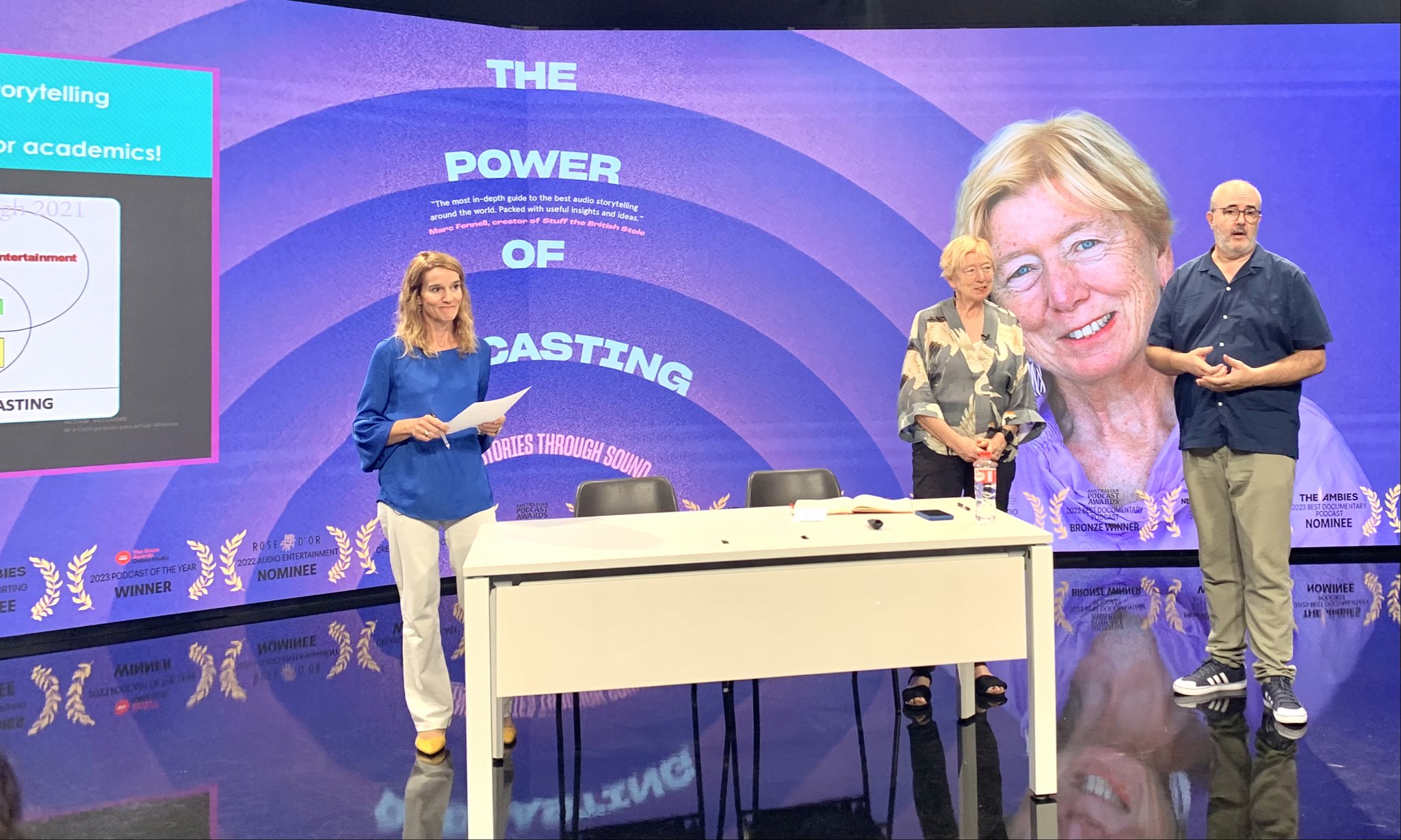
Being introduced at CEU San Pablo against a life-size image of my book!
ORAL HISTORY meets PODCASTING
For me, podcasts, radio documentary and oral history are interlinked, as I always turned my big oral history projects into an audio series, and sometimes a book as well. My first book was a social history of the Snowy Scheme, a huge hydroelectric project that became the birthplace of multiculturalism in Australia. I was lucky enough to interview many dozens of those European migrants who made a fresh start here after WW2 by working on it – and what a diverse, polyglot bunch they were. In October, for the 75th anniversary of the scheme’s launch, I got wheeled out again to talk about that remarkable time, when people of over 30 nationalities who’d been fighting each other only a few years before, came together in the rugged Australian Alps to build one of the engineering wonders of the world. Better still, I got to play audio clips from the original oral histories I recorded in 1987/88 – the full collection is archived in the State Library at Sydney.
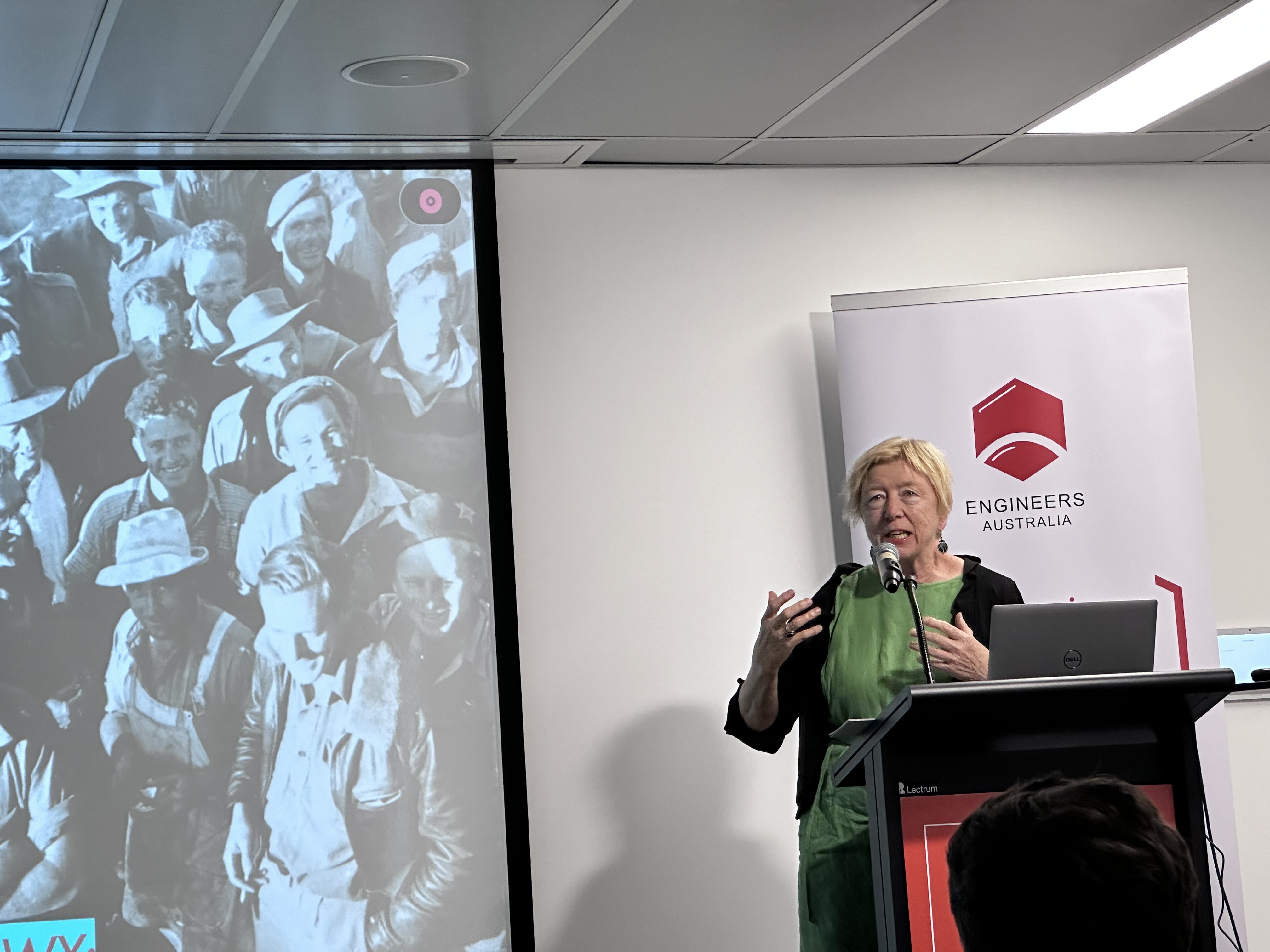
Speaking at the Engineers Australia event, slide of Snowy workers c. 1951 behind.
It was a delight to speak to 800 engineers (100 in the room and 700 online) to celebrate the scheme. Most were young, many of them migrants themselves, and the culture shock and gradual accommodations between ‘Old’ and ‘New’ Australians of the 1950s and ‘60s resonated. The event was introduced by the extraordinary Arnold Dix, a Snowy boy who grew up by Lake Jindabyne, created by the project. Arnold has several degrees, in geology, law and engineering, and puts them all to good use as head of ITA, the International Tunnelling and Underground Space Association. Over fish and chips afterwards, Arnold told me how he’d supervised the rescue of some 40 Indian miners after a tunnel collapse the year before.
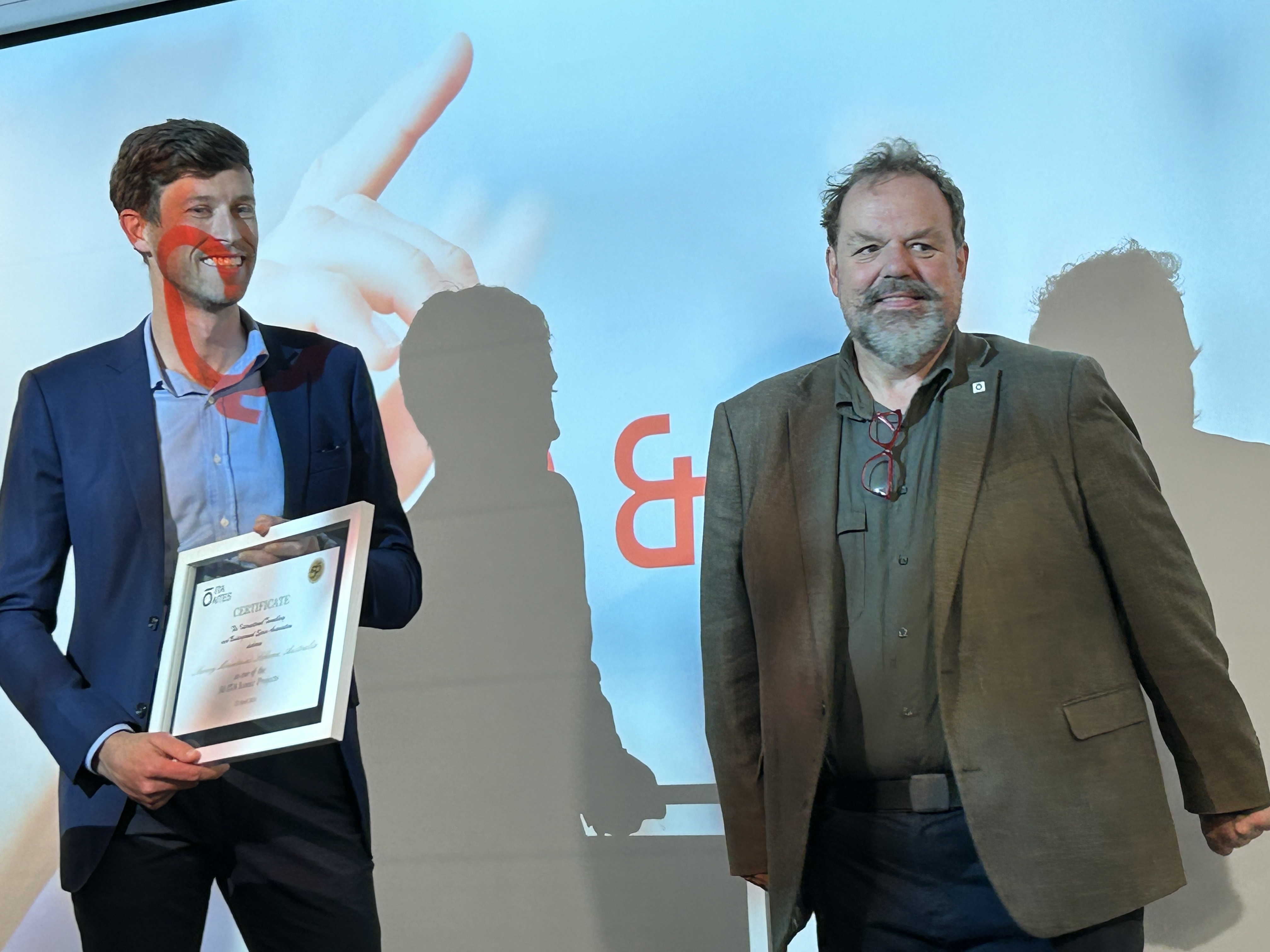
Arnold Dix (R) with Damon Miller, an engineer on Snowy 2.0, a current extension of the original project.
Arnold currently advises the UN and somehow runs a flower farm on the side. The Snowy is still producing great stories, 75 years on! I told several more of them on various ABC shows, including RN’s Late Night Live, where the redoubtable host David Marr rashly invited me to sing. Which is how my impromptu rendition of the old folk ballad, Put a Light in Every Country Window, was unleashed on an unsuspecting public.
In November, it was off to Melbourne for the Oral History Conference of Victoria. I loved meeting the current crop of practitioners and hearing about fascinating projects from interviewing centenarians to mapping Melbourne’s buskers as both a podcast and a PhD. But I was really hanging out to hear the keynote, by my inspiration of so many years, Alessandro Portelli, all the way from Rome. At 82, Sandro was as eloquent and insightful as ever on how we make meaning of our lives, and the stories we tell about them. He truly is the world’s most brilliant oral historian, as his colleague and friend Prof Alistair Thomson introduced him.
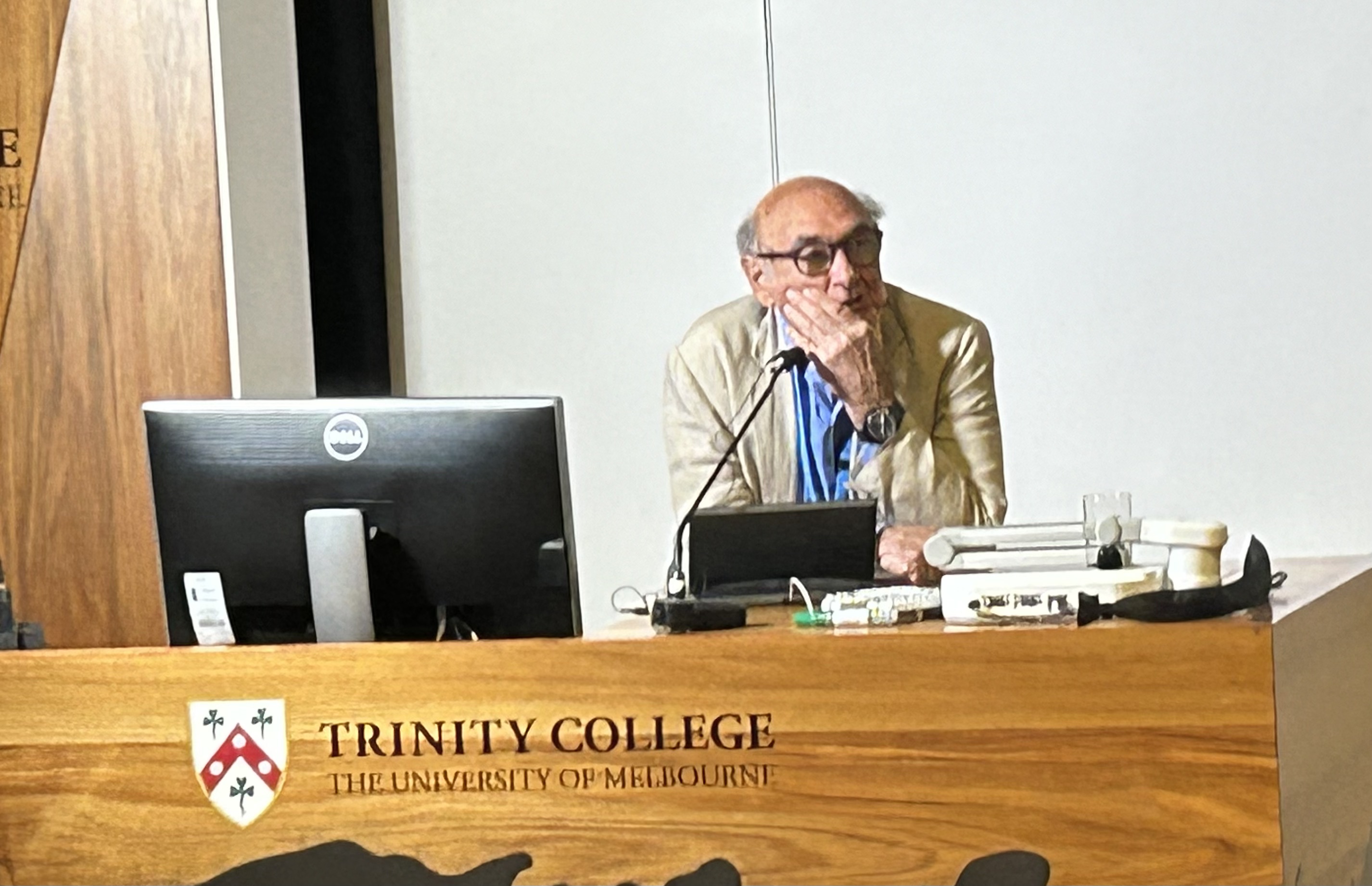
Alessandro Portelli delivering the keynote at OHA Victoria Conference, Nov 2024.
I was thrilled – and a bit nervous – when Sandro attended my own session, a masterclass on the making of The Greatest Menace. The format, of converting interviews to serialised storytelling, crafted with archival and ambient sound, was new to him, he told me – but ‘great’. That got me thinking: what if current podcast producers were to get together with Sandro, and ask him to select and discuss works from his archive? What a cracker podcast that would be – because the meaning and impact of oral history only deepens with age and fresh contexts. Later I introduced Sandro to some excellent Italian podcast academics and practitioners… and the excitement was mutual. Watch this space! This is where the fellowship and shared community of audio people is so rewarding.
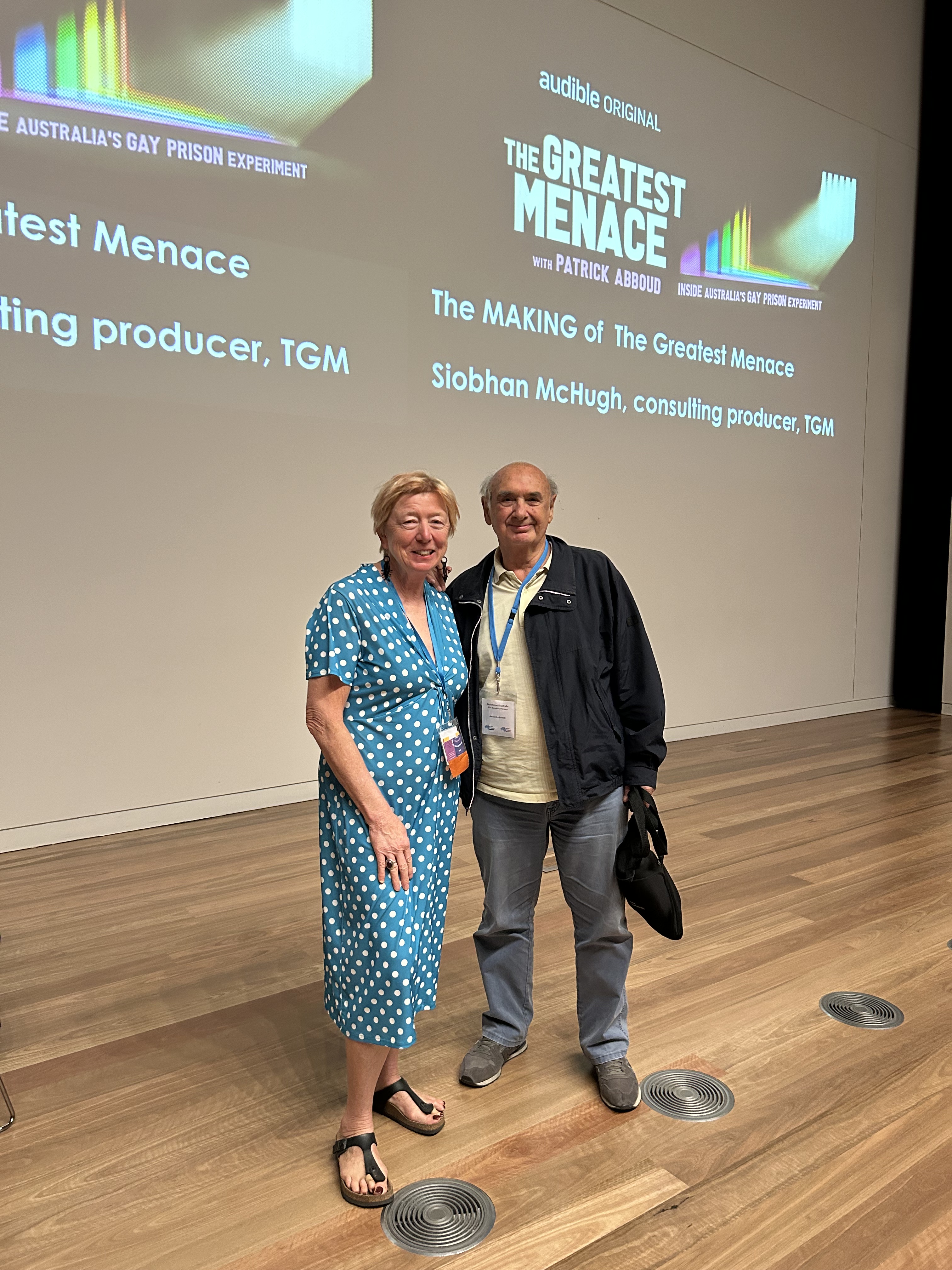
Honoured to have Alessandro Portelli attend my masterclass – and get interested in podcasts!
MY TOP PODCASTS for 2024
At year’s end, I delivered what has become an annual ritual – to select the year’s best podcasts for The Conversation. It’s always tough to whittle it down to ten, while trying to cover a range of genres and origins. There were obvious ones, such as The New Yorker and In The Dark’s forensic expose of US war crimes in Iraq. But there were also ones that might have flown beneath your radar, such as The Belgrano Diary, a tour de force hosted by the Scottish writer Andrew O’Hagan, laden with poetic, sonorous reconstructions and memorable observation. (‘He looked like he’d been on a lifelong gap year.’).
Some I couldn’t fit in include Trial by Water (revisits the ghastly story of the father who drove his three boys into a dam and adduces compelling new evidence), Cement City (a tender if overlong portrait of a declining US town) and Baghdad Nights (an examination by my old collaborator, Richard Baker – Phoebe’s Fall, The Last Voyage of the Pong Su – of the sordid macho world in which Australian wheat officials associated with the Saddam Hussein regime).
2025 is shaping up to be exciting.

I’m headed to Europe in Sept/Oct, to present at the International Oral History Conference in Krakow. The conference dinner is being held at the Kosciuszko Mound – a memorial to the great Polish freedom fighter, after whom Australia’s highest mountain is named. It’s in the Snowy Mountains, site of my first book. I love these synchronicities!
Meanwhile, it’s high summer here and I’m off to the beach with Godot dog. And yes, he’ll make us wait 😄

Happy New Year!
 Siobhan McHugh